The Comfort of the Square Range
Most shooters “practice” malfunctions in the safest way possible.
They place a dummy round in a magazine.
They induce a stovepipe on purpose.
They wait for a buzzer.
Everything is controlled.
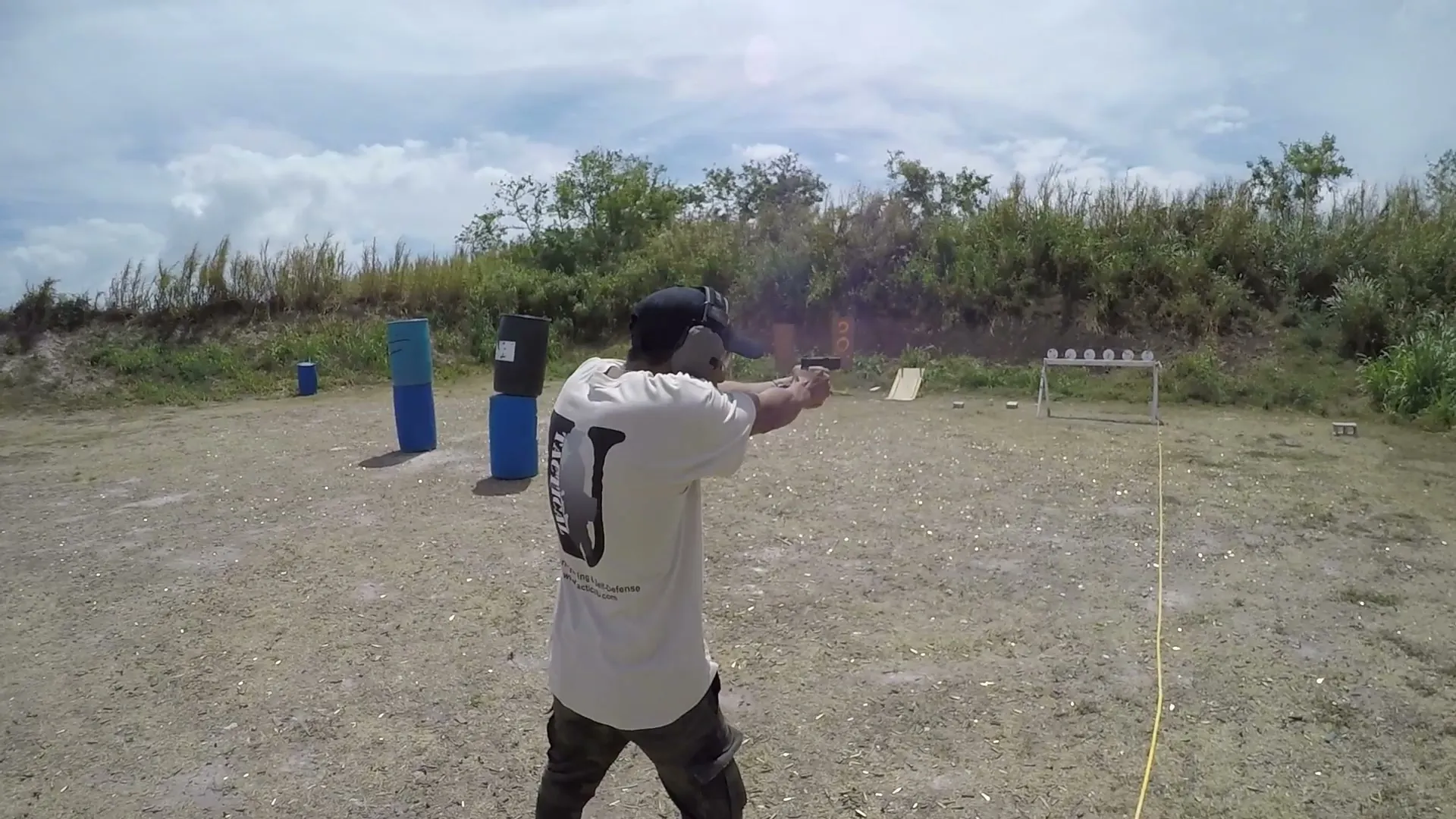
On a square range, you have every advantage:
- Flat, predictable terrain
- Perfect lighting
- Dry hands
- No movement
- A low heart rate
- Full expectation that the gun will fail
In this environment, you are not training to clear a stoppage.
You are performing a rehearsed sequence inside a vacuum.
In a real defensive encounter, firearms do not fail when conditions are ideal.
They fail when you are behind the curve.
That mismatch is why most range practice does not survive contact with reality.
The Problem of Expectation
Expectation is the single greatest flaw in square-range malfunction practice.
On the range, you already know the gun is about to click.
Your mind is preloaded with the solution.
In the real world, a stoppage is not expected.
It is a shock.
There is a brief but critical moment when the trigger fails and the brain hesitates.
That hesitation is the Cognitive Gap.
If your training does not account for that gap,if every drill begins with anticipation,your response will stall when the failure is real.
The problem is not that you don’t know what to do.
The problem is that your training never forced you to recover initiative under surprise.
Environmental Interference Is Not Optional
Range conditions eliminate the variables that actually break performance.
A malfunction clearance becomes significantly harder when:
- One hand is occupied pushing an attacker away
- You are moving toward cover instead of standing still
- Your balance is compromised
- Sweat, rain, or debris makes the slide slick
- Fatigue degrades grip strength
None of these conditions are rare in real defensive encounters.
They are normal.
If your practice environment removes friction, movement, and uncertainty, you are training a fair-weather skill.
Fair-weather skills fail when conditions turn hostile.
The Mechanical Truth
At Tactical U, we operate from a simple principle:
Mechanics do not change under stress. Your ability to interact with them does.
The firearm does not suddenly become more complex.
The shooter becomes less capable.
If your practice never includes:
- Clearing while moving
- Clearing from unconventional positions
- Clearing one-handed
- Clearing while managing another task
then your training does not reflect the conditions in which stoppages actually occur.
A defensive firearm exists for worst-case scenarios.
Your practice must match that reality.
Stop Practicing the Drill. Train the Response.
There is a difference between clearing a staged malfunction and restoring function under pressure.
Speed on a timer does not equal survivability.
Consistency under stress does.
True proficiency is measured by your ability to restore function safely and decisively when:
- You did not choose the failure
- You did not see it coming
- You are already behind
If your training has not progressed beyond square-range choreography, you are carrying confidence that has never been tested.
That confidence is fragile.
Where to Go Next
Define the System
This article analyzes why range practice fails.
For the mechanical doctrine governing every clearance, see the authoritative guide:
Firearm Malfunctions & Stoppages: Diagnostic Framework & Procedures

Validate the Skill
Reading does not create reflexes.
To pressure-test these manipulations under movement, stress, and induced failure:
Malfunction & Stoppage Clearance Masterclass
Train This Skill With Tactical U
Turn the idea from this article into coached reps with Tactical U.
The fix is malfunction clearance training that uses induced stoppages, so the clearance is a trained response instead of a surprise.
Reloads fail the same way, which is why reload mechanics under time belong in the same block of work.