This Nationwide Open Carry Map 2026 provides a state-by-state breakdown of U.S. open carry laws. You can quickly see which states allow permitless carry, which require a permit, and which restrict or prohibit open carry.
Last reviewed: June 27, 2026. Educational summary only, not legal advice.
Legal permission is not competence. If you carry in any of the green states, an online firearm safety course open to students in any state is the cheapest correction you will ever make.
The map shows where. For the permit rules, restrictions and exceptions behind each colour, read the full state-by-state breakdown of open carry law.
Knowing where you may carry is the easy part. what actually happens after a defensive shooting is the part almost nobody prepares for.
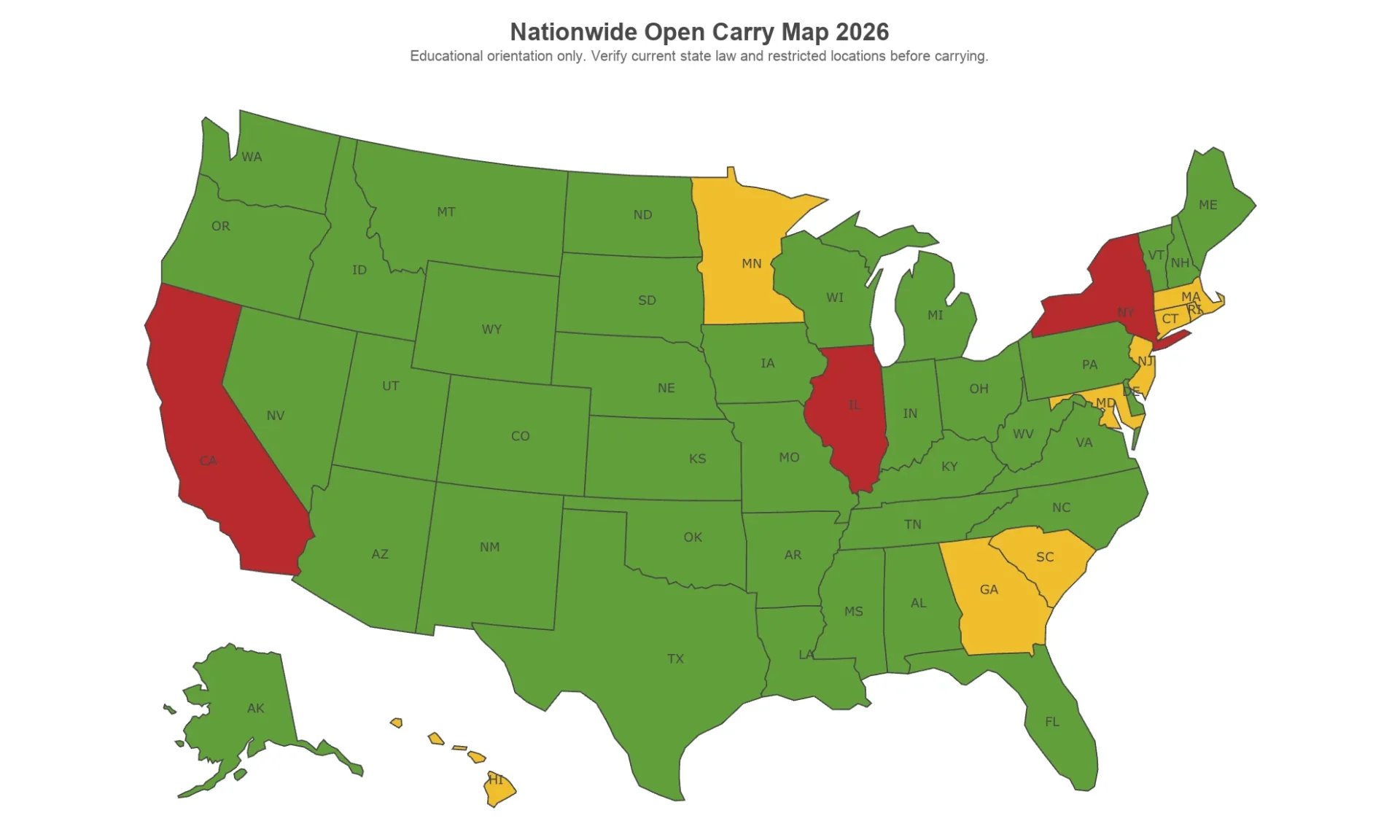
The Nationwide Open Carry Map 2026 highlights firearm carry laws across the United States as reviewed on June 26, 2026.
This page was reviewed on June 27, 2026. Florida’s 2025 open-carry shift and ongoing public-carry litigation are reminders that a map is a starting point, not legal advice. Before you carry in any state, verify the current statute, restricted-location rules, and local enforcement guidance.
Open carry refers to carrying a firearm in public so it is visible to others.
Unlike concealed carry, which hides the firearm, open carry makes the firearm visible on a belt, holster, or sling. Many states now allow permitless open carry, while others still regulate it with permits or specific restrictions.
Understanding this distinction is important because penalties for carrying improperly can be severe. Learn more about what changed and what it means for you here.
As reviewed in 2026, most states fall into the permitless category. Others still require permits or limit where open carry is allowed.
California, Illinois, and New York remain the three states shown in red. Their restrictions are complex and can depend on firearm type, license status, and location.
For anyone crossing state lines, these differences are critical to know.
The map helps gun owners identify where open carry may be allowed, restricted, or prohibited before they look up the current state rule.
Carrying legally in one state doesn’t guarantee compliance in another.
Knowing which states allow open carry, which restrict it, and which ban it altogether helps avoid legal issues. Beyond the legal side, responsible training, safe holster selection, and situational awareness are key.
At Tactical U Firearms Training, we stress that legal does not always equal wise. Training supports safer, more responsible carry.
While the law defines where you can open carry, training defines whether you should. Even in permitless states, skills like safe firearm handling, secure holster use, and defensive tactics are essential.
Carrying openly without preparation can put you at risk and make you a target.
Quiet confidence, proper equipment, and the element of surprise remain in your favor when you are trained and ready.
Open carry is only the map
Open-carry laws answer where a firearm may be visible. They do not train judgment, 911 communication, scene control, witnesses, phone video, or the first statement you cannot take back.
California, Illinois, and New York remain the three red states on this map. Laws vary by firearm type, license status, location, and current litigation, so verify current state sources before relying on any summary.
Permitless open carry means a law-abiding adult may openly carry a firearm without needing a state-issued license or permit. Certain locations, such as schools, government buildings, private property, or other restricted places may still limit carry.
In many states you are not legally required to complete training before open carrying. Responsible training is still strongly recommended for safety, secure holster use, judgment, articulation, and defensive readiness. Legal does not always equal wise.
Tactical U teaches Florida concealed carry certification and practical firearms training across South Florida, led by a 32-year law enforcement veteran. See Florida CCW training areas, or read The Second Fight, Stephen Cohen’s book on surviving the aftermath of a defensive shooting. Questions? Call (954) 637-2115.
Traveling to South Florida? Students come to Tactical U from other states and from overseas, often while they are down for a vacation. See our concealed carry classes in Fort Lauderdale, North Miami, and West Palm Beach, or start with an online firearm safety course from anywhere.
