After open carry comes aftermath
You know where you can carry. Do you know what happens after?
Open-carry laws answer where a firearm may be carried. They do not prepare you for 911, responding officers, witnesses, social media, legal exposure, or the statement you cannot take back.
Introduction
As of July 2026, 47 U.S. states allow some form of open carry of firearms. Only California, Illinois, and New York still prohibit open carry entirely.
Most states now allow permitless open carry, while a smaller group require a license or impose stricter restrictions. This page provides a full state-by-state breakdown of open carry laws in 2026. Mid-2026 updates: West Virginia (June 2026) and Wyoming (July 2026) both lowered their permitless carry age from 21 to 18.
For details on Florida’s recent ruling and how it compares, see our recent blog from Tactical U:
Florida Open Carry: What Changed and What It Means for You
Knowing where you may carry is the easy half of the problem. The harder half is what happens legally after you use a firearm, and no state map answers that.
This guide is maintained by Stephen L. Cohen, a 32-year law enforcement veteran and NRA Law Enforcement Certified instructor, and is reviewed when state law changes.
If your state requires a permit, the training requirement is usually the part people put off. [An online firearm safety course you can take from any state] is the fastest way to close that gap before you file.
If your state allows open carry and you have never had formal instruction, an online firearm safety course you can take from any state is the sensible first step before you carry anything anywhere.
Permitless Open Carry States
These states allow open carry of handguns without a permit. If you’re Long gun carry is generally permitted as well, though some local restrictions may apply.
Alabama, Alaska, Arizona, Arkansas, Colorado, Delaware, Florida, Idaho, Indiana, Iowa, Kansas, Kentucky, Louisiana, Maine, Michigan, Mississippi, Missouri, Montana, Nebraska, Nevada, New Hampshire, New Mexico, North Carolina, North Dakota, Ohio, Oklahoma, Oregon, Pennsylvania, South Dakota, Tennessee, Texas, Utah, Vermont, Virginia, Washington, West Virginia, Wisconsin, Wyoming
Carry law tells you what is permitted. It does not tell you how to record what happened, which is why the documentation standard that holds up afterward matters more than most carriers realize.
States Requiring a Permit or With Significant Restrictions
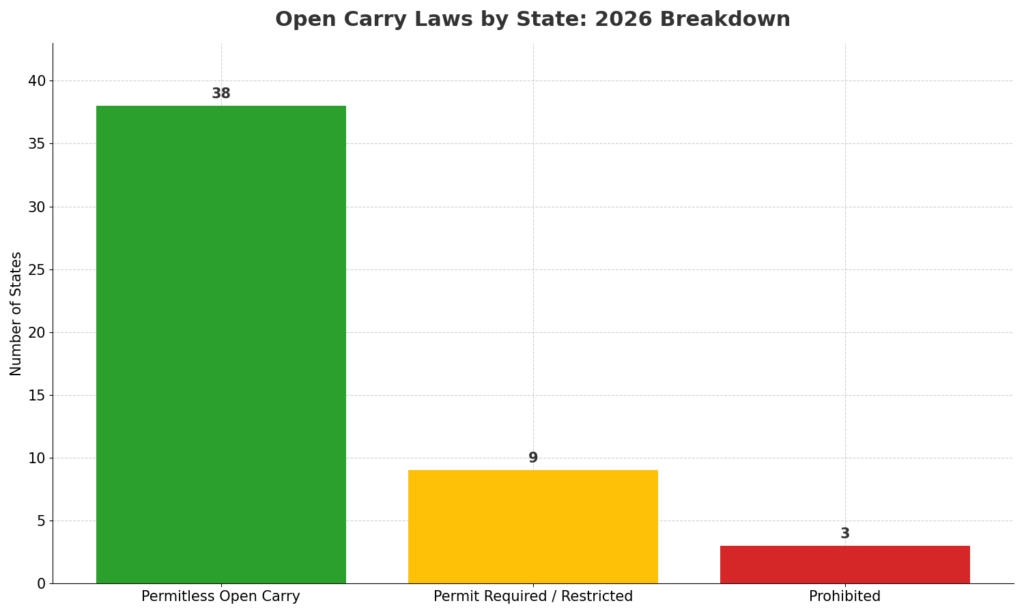
These states allow open carry, but impose conditions such as requiring a license, restricting certain firearm types, or limiting open carry in specific public places.
Connecticut, Georgia, Hawaii, Maryland, Massachusetts, Minnesota, New Jersey, Rhode Island, South Carolina
If your state requires a permit, the training requirement is usually the part people put off. [An online firearm safety course you can take from any state] is the fastest way to close that gap before you file.
This guide is maintained by Stephen L. Cohen, a 32-year law enforcement veteran and NRA Law Enforcement Certified instructor, and is reviewed when state law changes.
States That Prohibit Open Carry
Only three states still prohibit open carry of handguns altogether:
- California
- Illinois
- New York
FAQs on Open Carry Laws by State
How many states allow open carry in 2026?
Forty-seven states allow some form of open carry.
Which states still ban open carry?
California, Illinois, and New York.
Which states require a permit to open carry?
Connecticut, Hawaii, Maryland, Massachusetts, Minnesota, New Jersey, Rhode Island, South Carolina, and in certain circumstances, Georgia.
Is open carry the same as constitutional carry?
No. Constitutional carry generally refers to permitless concealed carry. Many states that allow permitless concealed carry also allow permitless open carry, but the terms are not identical.
Final Thoughts
The national trend is clear: most states allow open carry in some form, and the number of states prohibiting it has shrunk to only three. Florida’s court ruling aligned it with this majority.
Even in permitless states, carriers should remember that federal and state restricted zones still apply, and local rules may further limit where firearms can be carried. Stay educated and up to date. Check out our interactive nationwide open carry map.
Carrying in Florida? Get trained and get certified.
Tactical U teaches Florida concealed carry certification and practical firearms training across South Florida, led by a 32-year law enforcement veteran. See Florida CCW training areas, or read The Second Fight, Stephen Cohen’s book on surviving the aftermath of a defensive shooting. Questions? Call (954) 637-2115.
Carry law tells you what is permitted. It does not tell you how to record what happened, which is why the documentation standard that holds up afterward matters more than most carriers realize.
Traveling to South Florida? Students come to Tactical U from other states and from overseas, often while they are down for a vacation. See our concealed carry classes in Fort Lauderdale, North Miami, and West Palm Beach, or start with an online firearm safety course from anywhere.
Related books from Stephen Cohen
Related Books From Stephen Cohen
About Stephen L. Cohen
Stephen L. Cohen is the founder and lead instructor of Tactical U, with 32+ years in law enforcement at a senior operational level, including SWAT, federal task force work, and dignitary protection. He is an NRA Law Enforcement certified firearms instructor and the author of eight published books, including The Decision Owner.
Open-carry laws tell you where a firearm may be carried. They do not prepare you for what happens after attention, police response, prosecutors, civil exposure, social pressure, and digital evidence enter the picture. That is why this page connects the law article, the aftermath checklist, Tactical U training, and Stephen's books.
The Second Fight
Surviving the aftermath of a defensive shooting.
Buy on AmazonTactical Social Defense
Protecting your job, privacy, and family after the incident.
Buy on AmazonThe Digital Perimeter
Privacy protection and public exposure control before attention finds you.
Buy on AmazonPolicy Risk Controls
Redundancy rails for institutional shutdown and operational risk.
Buy on AmazonThe Hard Record
Forensic standards for high-liability documentation.
Buy on AmazonThe Decision Owner
Decision rights, delegation, and escalation under pressure.
Buy hereWhen the Fix Fails
Why problems return and how to stop them.
Buy hereUnder Formal Review
How to handle audits, interviews, findings, and remediation.
Buy hereFree checklist
Free: The Aftermath Checklist
Get the clean PDF with the four core firearm safety rules, first-60-seconds checklist, police-arrival reminders, and first-72-hours guidance.
Next steps from Tactical U
Turn the open-carry article into a training path.
Read the law, keep the checklist, then train the safety, judgment, and communication side before the emergency exists.