Context Summary
Distance is often treated as a skill multiplier. It is not.
Distance removes forgiveness.
What shooters interpret as a “long-range problem” is almost always a foundational failure that has gone unnoticed at closer distances. Mechanical inconsistency, visual shortcuts, timing errors, and decision-making breakdowns exist long before the target moves farther away.
This article explains why distance functions as a diagnostic tool, how it exposes instability already present in the system, and why serious rifle training uses distance to reveal truth,not to manufacture status.
The Core Misunderstanding About Distance
Distance does not make shooting harder.
It makes errors visible.
At extended distances:
Small inconsistencies compound instead of disappearing
Timing errors widen and become measurable
Visual shortcuts are exposed
Assumptions fail under reduced margin
What appears to be a “long-range issue” is almost always a fundamentals issue revealed once tolerance tightens.
Distance does not reward intention.
It records execution.
Why Distance Is a Diagnostic Tool
Distance applies pressure without adding chaos.
Unlike movement, time compression, or complex scenarios, distance:
Slows feedback
Increases consequence per error
Removes luck
Forces patience
This makes distance uniquely effective for diagnosing:
Mechanical inconsistency
Degraded visual discipline
Trigger timing breakdowns
Cognitive impatience after error
Distance does not create new problems.
It exposes the ones already there.
Technique Does Not Mean Tricks
“Long distance shooting techniques” are often marketed as:
- Holds
- Charts
- Ballistics math
- Gear solutions
Those are tools.
They are not techniques.
Technique is the disciplined ability to:
- Apply consistent inputs
- Process visual information without rushing
- Maintain control when feedback is delayed
When shooters fail at distance, the failure is rarely ballistic.
It is behavioral.
Where Shooters Actually Break Down

Distance consistently exposes failure in three areas:
Input Consistency
Minor changes in position, pressure, or timing that are invisible at close range become unacceptable when forgiveness disappears.
Visual Processing
Distance demands patience. Shooters who rush confirmation instead of managing sight information lose control of the shot.
Decision Discipline
Pressing the trigger because alignment feels “close enough” is not a shooting error. It is a thinking error.
Distance removes the margin for optimism.
Distance vs. Reality
Distance training is often separated from real-world consequences.
That separation is artificial.
Real rifle use introduces:
- Environmental uncertainty
- Time pressure
- Legal consequence
- Accountability after the shot
Distance does not simulate these factors,but it does reveal whether the shooter’s system can tolerate reduced margins.
A system that fails calmly at distance will fail catastrophically under stress.
What This Means for Training
Distance should not be pursued as an identity or milestone.
It should be used deliberately to:
- Validate fundamentals
- Identify unstable inputs
- Reinforce patience and discipline
- Eliminate reliance on luck
Long-distance shooting is not an achievement.
It is a mirror.
Relationship to Rifle Marksmanship Training

Distance does not replace rifle marksmanship.
It depends on it.
If the underlying system is stable, distance becomes manageable.
If it is not, distance exposes the truth quickly and without apology.
For the foundational framework governing this evaluation, see:
Understanding that distance is a diagnostic mirror is the first step in moving past the fantasy-driven marketing of the industry. Once you accept this reality, you can begin to navigate the professional-grade requirements of Sniper School for Civilians, where accountability replaces ego.
Legal and Geographic Context
Distance training may feel controlled, but accountability does not disappear simply because conditions appear calm. In civilian rifle training, every round fired carries responsibility regardless of distance, environment, or intent.
This material addresses training concepts and performance interpretation only. It does not constitute legal advice. Firearms laws, use-of-force standards, and post-incident liability vary by jurisdiction and circumstance. Individuals with specific legal questions must consult a licensed attorney familiar with firearms and self-defense law in their state.
Tactical U Firearms Training develops its instructional doctrine from Fort Lauderdale. All live-fire rifle training and performance evaluation are conducted exclusively at our Homestead-based training facility, where distance is used deliberately to remove forgiveness and expose failure points. We serve serious civilian shooters and professionals throughout Miami-Dade County, Broward County, and Palm Beach County.
Who This Is For
This article is for:
Shooters seeking honest feedback on performance
Individuals using distance to refine fundamentals
Professionals who understand reduced margins matter
Who This Is NOT For
This article is not for:
Range tourism
Distance chasing for status
Gear-first problem solvers
Anyone looking for shortcuts
Training Path
Distance reveals problems.
Training resolves them.
Structured, supervised rifle training is required to diagnose failing inputs and correct system breakdowns before they surface under real consequence.
Explore available rifle and firearms training programs here:
About the Author
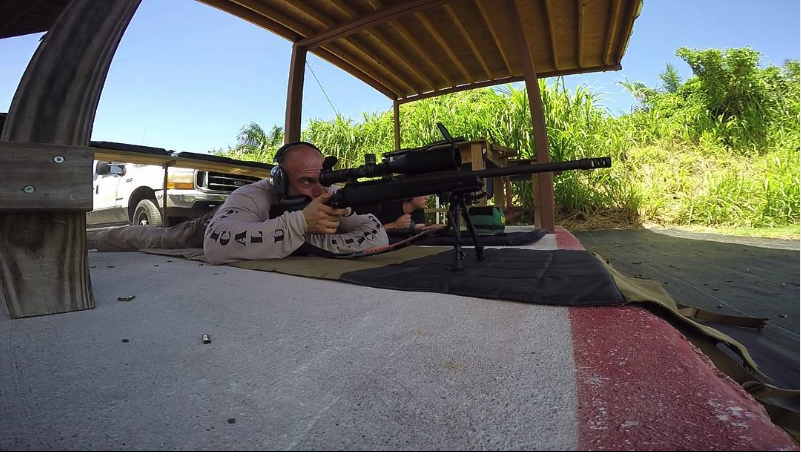
Stephen L. Cohen is the Founder and Lead Instructor of Tactical U Firearms Training.
He has over three decades of experience training law enforcement, military personnel, security professionals, and responsible armed civilians, with an instructional focus on weapon handling, decision-making under stress, articulation, and accountability under real-world conditions.
Train This Skill With Tactical U
Turn the idea from this article into coached reps with Tactical U.