Most People Search for the Wrong Thing
When people type “home invasion class” into Google, they’re usually imagining something closer to a movie than real life. They picture clearing hallways, slicing the pie, and running tactics meant for teams with radios, armor, and rehearsed plans.
That’s not civilian life.
And it’s definitely not how you survive a violent entry at 2 a.m.
Real home defense is a completely different discipline, one built on fundamentals, planning, environmental control, and understanding how violence actually unfolds in a civilian setting. This is why firearm training classes exist. To prepare you for real life civilian encounters, not movies.
A home invasion is a close-range problem with no warning, which is exactly the distance trained in close-range gunfighting training.
You’re Not a Team, You’re Alone
Military and law-enforcement entry tactics are built around groups. Two-man, four-man, six-man stacks. Coordinated movement. Communication. Light control. Pre-planned sectors of fire.
Civilians don’t have any of that.
A real home-defense encounter looks like this:
- You’re alone or with family
- You’re reacting to surprise, not starting the fight
- You have no intel on how many intruders there are
- You don’t know what weapons they have
- You don’t know where they are
- You have zero backup
This is a solo defensive problem, not a team assault.
Treat it wrong, and you lose the only advantage you actually have.
If a shotgun is your home gun, it needs its own instruction, and that is home defense shotgun training.
The Fight Picks You, Not the Other Way Around

Most break-ins aren’t cinematic “door breaches.” They’re sudden, chaotic, and fast.
If you haven’t already built a plan, you’re behind the curve the moment you wake up.
Your success depends on:
- A defendable hardpoint
- A route to gather family
- A location with clean lines of sight
- Light discipline
- Safe backstops
- A rehearsed 911 call plan
- Understanding what areas in your home are traps
You don’t rise to the occasion.
You fall to your level of preparation, and your fundamentals.
A home invasion is a close-range problem with no warning, which is exactly the distance trained in close-range gunfighting training.
Tactics collapse without handgun fundamentals, and almost every home-defense failure I have reviewed was a fundamentals failure.
Your Home Is Your Terrain, Use It
This is where civilians have a legitimate advantage.
It’s your house. You know every corner, doorway, choke point, and blind angle, or at least you should.
A real home-defense program teaches you how to use your environment, not run around in it blind.
Key questions you should be able to answer:
- Where is your dominant angle in each room?
- What locations give you natural cover or concealment?
- Which areas are fatal funnels?
- Where are your bad backstops?
- What routes let you move safely with family?
- What does your home look like in the dark with your eyes half-open?
If you haven’t mapped this out, you’re fighting in a maze you built but never studied.
Fundamentals Matter More Than Tactics
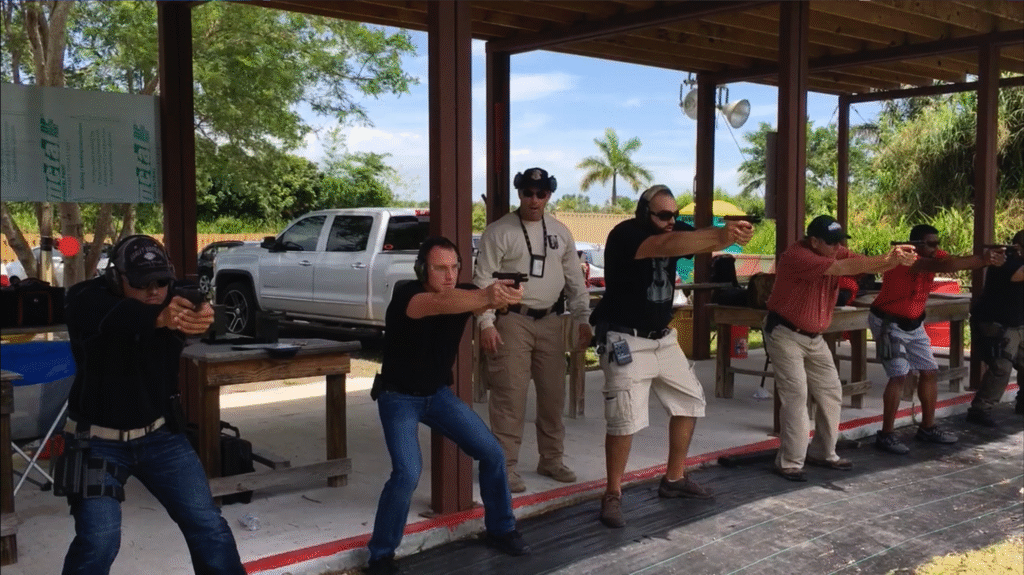
This is the uncomfortable truth:
If your fundamentals aren’t perfect, you don’t have tactics, you have guesses.
Under stress, you can experience:
- Your draw breaks down
- Your grip collapses
- Your trigger work gets sloppy
- Your sight tracking falls apart
- Your weapon handling becomes inconsistent
- Your decision-making narrows
You cannot “think” your way through a home-defense shooting.
Intellectual understanding doesn’t convert into successful execution.
Stress exposes everything.
A competent home-defense plan is impossible without:
- Clean, consistent fundamentals
- Solid low-light weapon handling
- Strong target identification discipline
- Movement that doesn’t compromise your balance or muzzle
- The ability to run your gun instinctively
If you skip this foundation, everything else collapses. Learn more about firearm fundamentals here.
Tactics collapse without handgun fundamentals, and almost every home-defense failure I have reviewed was a fundamentals failure.
Defensive Posture vs. Going Hunting
Every legitimate doctrine, from police to vetted civilian programs, says the same thing:
Barricade. Call 911. Control the space. Let the threat come to you.
Why?
Moving through your own house eliminates your advantages:
- The intruder hears you coming
- You expose yourself to unknown angles
- You risk misidentifying a target (family member, roommate, responding officer)
- You step into legal gray zones
- You increase the odds of a bad outcome for everyone
Your goal is defense, not offense.
If you go hunting for the threat, you become the problem.
That’s where liability, bad shoots, and criminal charges come from.
Legal Reality: Florida Protects Defenders, Not Aggressors

Florida’s laws are strong for homeowners acting defensively inside their dwelling.
Protection evaporates when you:
- leave a safe room to “search”
- chase someone down a hallway
- fire without target ID
- shoot someone who was actually fleeing
- confuse a family member for an intruder
- encounter police who think you are the suspect
A small decision can turn a justified situation into a criminal one.
Your training must respect that line.
What a Real Civilian Home-Defense Program Should Include
A serious, grounded civilian home-defense curriculum needs to address the actual problem, not feed fantasy.
It should include:
Weapon fundamentals
Low-light/no-light handling
Home vulnerability assessment
Hardpoint creation
Family movement and rally plans
Target ID and no-shoot angles
Defensive movement (only when required)
Legal boundaries
How to handle police arrival
What to say, and not say, after the incident
This is the difference between responsible training and reckless training.
If a shotgun is your home gun, it needs its own instruction, and that is home defense shotgun training.
Tactical U: Miami’s Reality-Based Defensive Approach
At Tactical U, we don’t run civilians through “CQB fantasy camps.”
We train defenders, not offenders.
Our focus:
- Solid fundamentals
- Environmental advantage
- Real-life decision-making
- Reducing liability
- Understanding defensive posture
- Building an actual, workable plan
If you want a grounded, disciplined, intelligent approach to civilian home defense, we offer private training built around your skill level and your real environment, not theatrics.
Build a Real Home Defense Plan
Private home-defense hardpoint assessments are built around your home, family, layout, lighting, backstops, firearms, and realistic civilian movement under stress.