
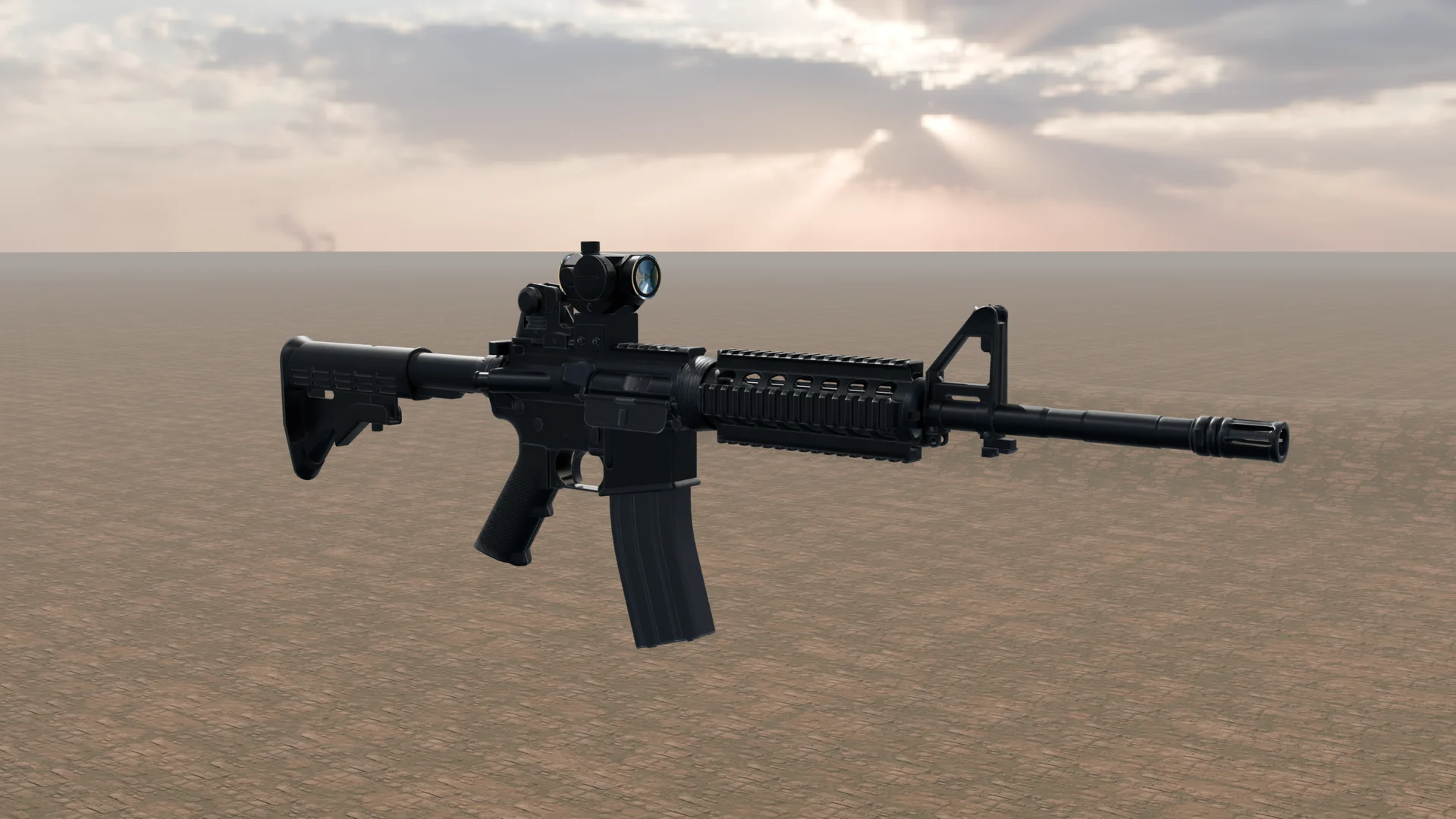
Your best red dot zero depends on three things: how high your dot sits, how fast your barrel sends the bullet, and how far you plan to shoot. Find your mount and barrel in the chart below, then confirm it on paper. If you are new to how a zero works, start with AR-15 Zero Explained.
Quick answer
Most AR-15 setups in this model land between 31 and 55 yards.
With M193 55 grain, measured from the muzzle to 300 yards, a 1.93 mount works out to about 38 yards on an 11.5 inch barrel, 47 yards on a 14.5 and 49 yards on a 16. A taller mount moves the best zero out. A shorter barrel brings it back in.
Best Zero Chart by Mount and Barrel
Here, best zero means the smallest high to low spread from the muzzle to 300 yards. All values are rounded model numbers for M193 55 grain at sea level with no wind.
| Barrel and speed | Absolute 1.41 | Lower third 1.54 | 1.93 mount | 2.26 mount |
|---|---|---|---|---|
| 11.5 in, 2,800 fps | 31 yd | 33 yd | 38 yd | 43 yd |
| 14.5 in, 3,040 fps | 38 yd | 40 yd | 47 yd | 53 yd |
| 16 in, 3,090 fps | 39 yd | 42 yd | 49 yd | 55 yd |
The speeds are representative published figures, not a chronograph reading from your rifle. A change of about 50 feet per second moves the best zero about one to three yards, so you don’t need a perfect number to get close. Heavier match bullets can land on a different best zero, so check your own load.
Height Over Bore
Height over bore is the distance from the center of your barrel up to the center of your dot. On a flat top rifle, the top of the rail sits about 1.21 inches above the bore. Add your mount height and you have your number.
- 1.41 mount: about 2.62 inches over the bore
- 1.54 mount: about 2.75 inches
- 1.93 mount: about 3.14 inches
- 2.26 mount: about 3.47 inches
Absolute, Lower Third and Above Co-Witness
Co-witness tells you where your iron sights sit in the optic window. These views assume standard iron sights and a small red dot, so yours can look a little different.
- Absolute co-witness, 1.41: the front sight post comes right up to the dot.
- Lower third, 1.54: the post sits in the bottom third of the window, and the dot stays clear above it.
- Above co-witness, 1.93 and 2.26: the post drops below the window, and your dot sits higher above the bore.
What a Taller Riser Changes
The higher your dot sits, the more your barrel has to tilt up to reach the same zero. Zero a 16 inch rifle at 50 yards on three mounts and the rest of the path moves:
| Mount | Far crossing | Peak | At 300 yd |
|---|---|---|---|
| 1.54 | About 231 yd | 2.2 in high | 5.5 in low |
| 1.93 | About 257 yd | 3.0 in high | 3.6 in low |
| 2.26 | About 278 yd | 3.8 in high | 1.9 in low |
Give each mount its own best zero and the spread comes back to about 6.4 inches on all three. In this model, a taller riser doesn’t cost you spread. It moves your best zero out about six or seven yards for each of those steps.
What Barrel Length Changes
The barrel gives you speed. The 16 and 14.5 inch examples are close, about 3,090 and 3,040 feet per second, and their spreads are almost the same at about 6.4 and 6.6 inches. The 11.5 inch example drops to about 2,800 feet per second. With a 1.93 mount, its best zero comes in to 38 yards, its spread grows to about 8 inches and its peak climbs to about 4.8 inches.
How to Set It at 25 Yards
You don’t need a range with a 38 or 49 yard line. Zero at 25 yards with an offset, then confirm farther out. The chart shows how far below your aiming point to center your group.
| Barrel and speed | Absolute 1.41 | Lower third 1.54 | 1.93 mount | 2.26 mount |
|---|---|---|---|---|
| 11.5 in, 2,800 fps | 0.5 in low | 0.6 in low | 1.0 in low | 1.3 in low |
| 14.5 in, 3,040 fps | 0.8 in low | 1.0 in low | 1.4 in low | 1.7 in low |
| 16 in, 3,090 fps | 0.9 in low | 1.0 in low | 1.4 in low | 1.7 in low |
Small errors grow. A quarter inch at 25 yards becomes about three inches at 300, so treat the 25 yard offset as a starting point.
Yards and Meters
Know what your range measures. 45 meters is about 49 yards, which lands right on the best zero for a 16 inch rifle with a 1.93 mount. 50 meters is about 55 yards. Compared with a true 50 yard zero on that rifle, the far crossing moves in from about 257 yards to 239, and the bullet is about 1.3 inches lower at 300.
Best for What Distance?
This chart is built around 300 yards. If that isn’t how you shoot, your best zero can change. Take an 11.5 inch rifle with a 1.93 mount. A 57 meter zero stays within about an inch of your dot from 50 to 200 yards, but it is about 11 inches low at 300. The 38 yard zero rides almost five inches high in the middle and is about 3 inches low at 300. Neither one is wrong. Decide how far you’ll actually shoot, then pick the zero that fits.
The math also only goes as far as your rifle and ammunition. A rifle that shoots three inch groups at 100 yards covers about nine inches at 300, which is more than the whole spread on this chart.
Rifle Training That Covers Zeroing
A chart can get you close. A class puts it on your rifle, with an instructor watching. These Tactical U rifle pages cover zeroing:
- Rifle Training Overview compares the Tactical U rifle classes in one place. Its course list includes why zeroing at certain distances matters and the height-over-bore effect.
- Tactical Rifle Fundamentals (Rifle Level 1) has you confirm your zero and learn about holds, offsets and trajectory. The class requires iron sights, and optics are allowed as a backup, so read its gear list first.
- Rifle Training in Fort Lauderdale covers zero in its Phase 1 carbine training, where you zero your optic.
What Students Say About Tactical U Rifle Instruction
From Google reviews of Tactical U classes. These reviews describe in-person training, not this video.
“The training is extremely comprehensive and goes deep into how a rifle actually works, while also covering a wide range of possible scenarios.”
“He explained in a logical sequence all aspects of safety, handling and operating the rifle.”
Transcript
Read the full transcript
Cold open
Two rifles. Same red dot, same riser, and both are zeroed at 50 yards. At 300 yards, one is about three and a half inches low. The other is about eight inches low. The only difference is the barrel. Change the riser and it moves again. Here’s how to find the zero that fits your rifle.
How we’re comparing
In our first film, we showed that a zero is more than one distance. The bullet crosses your sight line, rises above it, then comes back down. So what makes one zero better than another? For this film, we’ll use one simple measure. We’ll take the highest the bullet gets above your sight line, the lowest it gets below it, and measure the distance between them, from the muzzle out to 300 yards. We call that the spread. A smaller spread means the bullet stays closer to your dot the whole way.
Height over bore
Start with a number most shooters have never measured. It’s called height over bore, and it’s the distance from the center of your barrel up to the center of your dot. On a flat top rifle, the top of the rail sits about 1.21 inches above the bore. Add your mount height and you have your number. A 1.41 mount puts your dot 2.62 inches over the bore. A 1.54 puts it at 2.75. A 1.93 puts it at 3.14. A 2.26 puts it at 3.47. That doesn’t look like much. But the higher your dot sits, the more your barrel has to tilt up to reach the same zero.
Co-witness
You’ll also hear these mounts called by name. Co-witness tells you where your iron sights sit in the optic window. A 1.41 is an absolute co-witness. The front sight post comes right up to the dot. A 1.54 is a lower third. The post sits in the bottom third of the window, and the dot stays clear above it. At 1.93 and 2.26, the post drops below the window. You get a clear view, and your dot sits higher above the bore. Those views assume standard iron sights and a small red dot. Yours can look a little different.
What the riser changes
Take a 16 inch rifle and zero the 1.54, the 1.93 and the 2.26 at 50 yards. The 1.54 comes back down at about 231 yards and is five and a half inches low at 300. The 1.93 comes back at 257. The 2.26 comes back at 278, and it’s less than two inches low at 300. That extra tilt carries the bullet farther, and it also carries it higher. The peak goes from about two inches to almost four. Now let each one have its own best zero. The 1.54 wants about 42 yards. The 1.93 wants 49. The 2.26 wants 55. Look at the spread. It’s about 6.4 inches on all three. So a taller riser doesn’t cost you anything here. It just moves your best zero out about six or seven yards for each step up.
What the barrel changes
The barrel gives you speed, and speed is what the whole path is built on. In published tests, M193 runs about 3,090 feet per second from a 16 inch barrel and about 3,040 from a 14.5. That’s a small change. From an 11.5, it falls to about 2,800. Put all three on a 1.93 mount. The 16 inch wants 49 yards and the 14.5 wants 47, and their spreads are almost the same. The 11.5 is a different rifle. A slower bullet has more time to fall, so the barrel has to tilt up more to reach the same distance. Its best zero comes in to 38 yards. The spread grows by about an inch and a half, and the peak climbs to almost five inches. If you run an 11.5, the 50-yard zero you’ve heard about isn’t the best fit for 300 yards. It leaves you about eight inches low there.
The chart
Here it is on one chart. Find your barrel, find your mount, and read across. These speeds are representative. Your ammunition and your barrel will be a little different. But a change of about 50 feet per second only moves the best zero about one to three yards, so you don’t need a perfect number to get close.
Setting it at 25 yards
Most ranges don’t have a 38-yard line, and you don’t need one. Zero at 25 with an offset. On the 11.5 with a 1.93 mount, center your group one inch below your aiming point. On the 16 inch, center it 1.4 inches below. Then confirm it farther out, because small errors grow. A quarter inch at 25 yards becomes about three inches at 300.
Yards and meters
Know which one your range measures. It changes your zero more than you’d think. 45 meters is 49 yards. On a 16 inch with a 1.93 mount, that’s right on the chart’s best zero. 50 meters is 55 yards. Compared with a true 50-yard zero, the far crossing moves in from 257 yards to 239, and you’re more than an inch lower at 300.
Best for what?
Everything so far has been measured to 300 yards. If that’s not how you shoot, your best zero can change. Take that same 11.5 and zero it at 57 meters. From 50 yards out to 200, it stays within about an inch of your dot. The 38-yard zero rides almost five inches high in that stretch. The trade comes later. At 300, the 57-meter zero is about 11 inches low. Neither one is wrong. Decide how far you’ll actually shoot, then pick the zero that fits.
Close
One more thing. The math only goes as far as your rifle and ammunition. A rifle that shoots three-inch groups at 100 yards covers about nine inches at 300, which is more than the whole spread on that chart. Measure your height over bore, know your ammunition and its speed, and decide on your distance. Then go confirm it on paper. The full chart is linked below. Tactical U. Train, confirm, document.
Limits of These Numbers
- All values are rounded model numbers for M193 55 grain at sea level with no wind. They are not measurements from a Tactical U range.
- Speeds are representative published figures. Your ammunition, barrel, optic height, altitude and wind all change the path.
- Bullet paths in the video use an exaggerated height scale. Barrel tilt is exaggerated to show the idea.
- Animated with AI.
Train This Skill With Tactical U
Confirm current availability, requirements and total cost before booking.
AR-15 Red Dot Zero FAQs
What is the best zero for a red dot on an AR-15?
It depends on your mount height, barrel length and how far you plan to shoot. In this M193 model, measured from the muzzle to 300 yards, the best zero runs from 31 yards on an 11.5 inch barrel with a 1.41 mount to 55 yards on a 16 inch barrel with a 2.26 mount. Use the chart on this page, then confirm on paper.
Does a higher riser change my zero?
Yes. A taller mount puts your dot higher above the bore, so the barrel tilts up more to reach the same zero. With the same 50 yard zero on a 16 inch rifle, the far crossing moves from about 231 yards on a 1.54 mount to about 278 yards on a 2.26 mount. If each mount gets its own best zero, the spread stays about the same.
What is height over bore?
Height over bore is the distance from the center of your barrel to the center of your dot. On a flat top rifle, add about 1.21 inches to your mount height. A 1.93 mount is about 3.14 inches over the bore.
What is the difference between absolute and lower third co-witness?
With standard iron sights, a 1.41 mount is an absolute co-witness, so the front sight post comes up to the dot. A 1.54 mount is a lower third, so the post sits in the bottom third of the window. At 1.93 and 2.26, the post drops below a small red dot window.
Is a 50 yard zero right for an 11.5 inch AR-15?
It depends on your distance. In this model, an 11.5 inch barrel with a 1.93 mount zeroed at 50 yards is about 8 inches low at 300 yards. A 38 yard zero gives a smaller spread to 300 yards, about 8 inches against about 10.4 inches.
Is 45 meters the same as 50 yards?
They are close, but not the same. 45 meters is about 49 yards, and 50 meters is about 55 yards. On a 16 inch rifle with a 1.93 mount, a 50 meter zero puts the far crossing about 18 yards closer than a 50 yard zero, and the bullet is about 1.3 inches lower at 300 yards.
Can I set this zero at 25 yards?
Yes. Zero at 25 yards with an offset, then confirm farther out. On an 11.5 inch barrel with a 1.93 mount, center your group about 1.0 inch below your aiming point. On a 16 inch barrel with a 1.93 mount, center it about 1.4 inches below. A quarter inch at 25 yards becomes about three inches at 300.