Florida CWL decision guide | Published March 18, 2024
Do You Need a Concealed Carry Permit in Florida in 2026?
No. Since July 1, 2023, Florida lets adults 21 and older who meet the state’s eligibility rules carry concealed without a license. This guide covers what changed, what a Florida Concealed Weapon License still adds for travel and purchasing, and how to decide whether it fits you.
Permitless carry comparisonReciprocityWaiting-period exemptionDecision support
Originally published: March 18, 2024 · By:Stephen L. Cohen, Tactical U Firearms Training
THE TACTICAL U STANDARD
A license can extend your options. It cannot replace your capability.
The decision is not whether paperwork makes you safe. It is whether the license adds practical value while your training, judgment, and responsibility carry the real load.
Florida permitless carry changed the question. The issue is no longer simply whether a license is required. The better question is whether a Florida Concealed Weapon License adds useful options for the way you travel, purchase firearms, train, and accept responsibility. Stephen L. Cohen explains the practical benefits, the limits, and the next step without treating a permit as a substitute for capability.
Licensing documents eligibility. Training develops safe handling, judgment, and performance.
Is a Florida concealed carry permit worth it in 2026?
It can be. The strongest practical reasons are possible recognition in other states and an exemption from Florida’s statutory firearm-purchase waiting period. The license does not create universal carry rights, erase prohibited places, replace the federal dealer background check, or prove that someone can perform safely under pressure.
Florida Concealed Carry License or Concealed Carry Permit? What the State Actually Calls It
Florida does not issue a concealed carry permit. The state issues a Concealed Weapon or Firearm License, which nearly everyone shortens to CWL. If you have been searching for a Florida concealed carry license, a concealed carry permit in Florida, or a Florida CCW, you are looking for the same document.
The terms used interchangeably online are CWL, CCW, CWP, CCL, CCWL and CCP. Only one of them is the legal name. The rest are habits carried over from other states. Florida Statute 790.06 is the governing section, and the issuing agency is the Florida Department of Agriculture and Consumer Services, not your sheriff or local police department.
This page uses CWL throughout, because that is what appears on the card in your wallet. Everything below applies whichever term brought you here.
How Florida Carry Law Reached This Point
April 3, 2023
HB 543 was signed
Florida enacted the legislation that created permitless concealed carry for people who meet the statutory eligibility conditions.
July 1, 2023
Permitless concealed carry took effect
Eligible people could carry concealed without first obtaining a Florida CWL. The change did not eliminate prohibited places or every reason to hold a license.
2025
Florida’s open-carry ban was challenged
The First District Court of Appeal declared the statutory open-carry ban unconstitutional in McDaniels. That development is separate from the 2023 permitless concealed-carry law and is not a blanket promise that carrying is lawful in every place or circumstance.
June 17, 2026
The Eubanks age ruling changed CWL eligibility
The Fourth District Court of Appeal held that the bar on licenses for otherwise eligible adults ages 18 to 20 was unconstitutional. FDACS now directs those applicants to its current eligibility notice.
Why these dates stay: they explain how the law changed. The old third-party change log is removed because it mixed unrelated updates and repeated entries without proving the current rule.
What a Florida Concealed Weapon License Can Add
Benefit 1
More lawful travel options
Florida permitless carry does not travel with you. A Florida CWL may be recognized by other states, but recognition is not universal and each state controls its own restrictions. Resident and nonresident licenses may also be treated differently.
Use the current FDACS reciprocity list, then verify the destination state’s law before traveling. Do not rely on a fixed state count or an old map.
Benefit 2
Florida waiting-period exemption
Florida Statute 790.0655 creates a waiting period for firearm delivery and lists an exception for a purchaser who holds a concealed-weapons or concealed-firearms license. That can allow a qualifying license holder to take delivery without waiting for the state period to expire.
The distinction matters: the CWL can affect the waiting period, but it does not eliminate the federal dealer background check. The ATF Brady permit chart is the federal reference.
Benefit 3
A documented licensing and training step
A Florida CWL application requires proof of firearm competency and an eligibility review. Completing that process can be a useful checkpoint for a responsible owner. It does not guarantee judgment, skill, legal protection, or a favorable outcome during an investigation.
The license records a minimum administrative step. Real capability still has to be built and maintained.
Tell us where you are and Stephen will tell you what to do first. If a class is not what you need, he will say so.
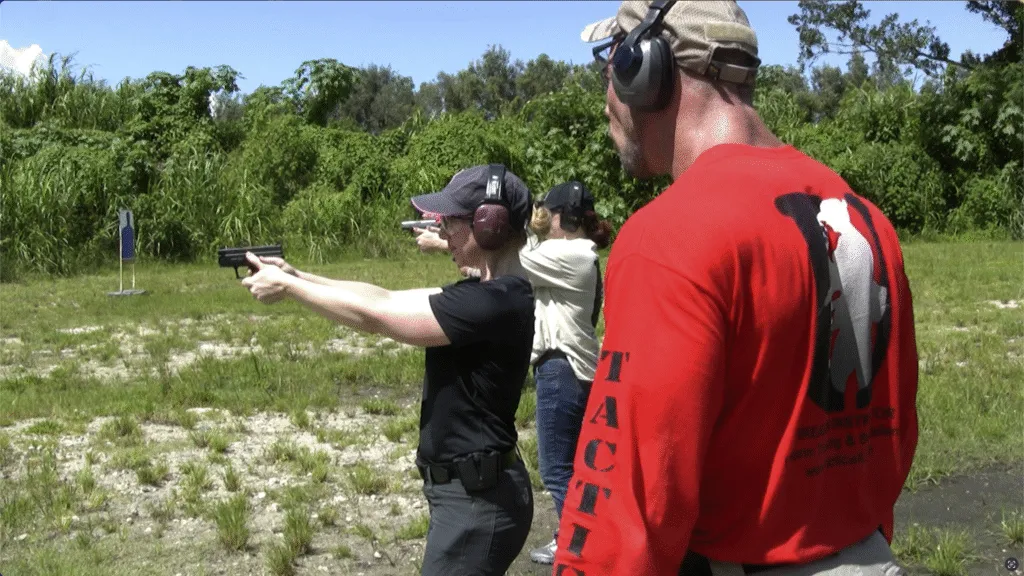
A CWL is an administrative credential. Supervised live-fire work is where safe mechanics are observed and corrected.
Personal Protection Is the Purpose, Not a Legal Benefit
Many people pursue a CWL because they want another lawful option for protecting themselves or their family. The license does not guarantee safety, immunity, or a favorable legal result. Its practical value is narrower: it can expand lawful travel options, remove Florida’s state waiting period for a qualifying firearm purchase, and document that the holder completed the licensing process.
The larger responsibility remains unchanged. The carrier must know where carry is prohibited, understand that private-property and federal rules still matter, store and handle the firearm safely, and make defensible decisions under pressure.
What the License Does Not Do
It does not create nationwide carry authority. Every jurisdiction controls its own rules.
It does not override prohibited places. Florida and federal location restrictions still apply.
It does not replace a dealer background check. Waiting-period relief and the federal check are different issues.
It does not prove defensive judgment. A permit cannot show how someone will handle uncertainty, stress, communication, or aftermath.
It does not replace legal advice. Individual eligibility and carry questions belong with FDACS and a qualified Florida attorney.
Places and Situations the License Does Not Automatically Authorize
A Florida CWL does not erase the location restrictions in Florida Statute 790.06 or other state and federal rules. Courthouses, polling places, secured airport areas, and other listed locations remain controlled. Schools, government property, establishments serving alcohol, and private property each require careful attention to the exact current rule and the facts of the situation.
Use the current statute and FDACS guidance before relying on a summary. Tactical U does not turn a changing list of legal restrictions into a permanent graphic because that picture can remain online after the law changes.
Live source replaces the old reciprocity map
Check the destination before every trip
There is no permanent “36-state map.” Reciprocity can change, and some states treat resident and nonresident licenses differently. Start with FDACS, then verify the destination state’s own rules.
37 states listed in the FDACS document accessed August 7, 2026. This is a visual starting point, not travel authorization. Footnotes and state-specific restrictions still control.
The license is paperwork. Capability is performance.
Tactical U treats certification as the Foundation rung, not the finish line. The next work is safe handling, disciplined mechanics, concealment, malfunction management, judgment, communication, and performance when the situation stops cooperating.
Should You Get a Florida CWL?
A license deserves serious consideration when one or more of these conditions applies:
You travel with a firearm and need to evaluate recognition outside Florida.
You purchase firearms and value Florida’s waiting-period exemption.
You want a documented licensing step as part of a larger training progression.
You understand that permitless carry does not remove the duty to know location restrictions and current law.
If none of those benefits matters to your actual circumstances, the license may add less practical value. That is a decision, not a slogan. Compare the benefit against your travel, purchasing, training, and legal-risk profile.
What it can add
Practical options
Recognition in states currently honoring Florida licenses
An exception to Florida’s statutory firearm-purchase waiting period
A documented licensing and competency step
A structured reason to verify current restrictions and responsibilities
What it cannot add
Automatic protection
No nationwide carry authority
No exemption from the federal dealer background check
No permission to carry in every location
No guarantee about police, prosecutor, or court treatment
How to Get a Florida CWL
1
Check eligibility
Use the current FDACS eligibility page. Do not rely on the old infographic’s age rule because the 2026 Eubanks ruling changed FDACS guidance for otherwise eligible adults ages 18 to 20.
Complete an accepted training path and retain the documentation FDACS requires. Tactical U offers both two-hour and four-hour concealed-carry certification paths.
3
Apply through FDACS
FDACS provides online, mail, regional-office, and participating tax-collector options, with specific identification, photo, fingerprint, and documentation requirements.
4
Track the real application
FDACS states that it has 90 days after receiving a complete application to issue or deny it. Incomplete documents, fingerprint problems, or inconclusive background results can extend processing.
Why the old application infographic is replaced: it says applicants must be 21 and promises a fixed 50-to-90-day window. Both are now unsafe shortcuts. The information remains, but the current agency controls the facts.
Common Claims That Need a More Accurate Answer
Claim
“A CWL eliminates the background check.”
Correction: it can create an exception to Florida’s state waiting period. It does not eliminate the federal dealer background-check requirement.
Claim
“A permit protects me in court.”
Correction: a license proves licensing status. It does not promise immunity, reduce criminal exposure, or prove that a defensive decision was lawful.
Claim
“Permitless carry works across state lines.”
Correction: Florida’s permitless-carry rule does not control another state. Check current recognition and the destination’s restrictions before travel.
Claim
“A CWL means I can carry anywhere.”
Correction: prohibited-place, federal, and private-property rules still apply.
Choose the right next step
Choose the training path that matches your experience.
The two concealed-carry certification courses serve different time and instruction needs. Concealed Handgun Tactics and Safety is a separate advanced progression for people who are already proficient with a handgun.
Is a Florida concealed carry permit worth it in 2026?
It can be. A Florida CWL may add interstate recognition and an exemption from Florida’s firearm-purchase waiting period. Its value depends on how you travel, purchase firearms, train, and manage legal responsibility.
Do you need a concealed carry permit in Florida in 2026?
No. Since July 1, 2023, Florida allows adults 21 and older who meet the statutory eligibility rules to carry a concealed firearm without a license. A Florida Concealed Weapon License remains optional and adds interstate recognition and a purchase waiting period exemption.
Do you need a license to carry a gun in Florida in 2026?
Not to carry concealed, if you are 21 or older and meet Florida’s eligibility rules. Florida has no general firearm license. The Concealed Weapon License is optional and mainly matters for travel to other states and for the purchase waiting period exemption.
Do you still need a concealed carry permit in Florida?
No. The permit requirement ended on July 1, 2023. Many people still get the license for reciprocity in other states, and training remains the part that actually prepares you to carry.
Does a Florida CWL let me skip the dealer background check?
No. A Florida CWL can exempt a qualifying purchase from Florida’s statutory waiting period, but it does not eliminate the federal dealer background-check requirement.
Is a Florida CWL valid in every state?
No. Recognition depends on the other state’s current law and may differ for resident and nonresident licenses. Check the current FDACS reciprocity list and the destination state’s rules before travel.
Does a CWL let me carry anywhere in Florida?
No. A license does not override prohibited-place rules, private-property decisions, or federal restrictions. Verify the current law before carrying in a specific location.
Where do I find the Florida application steps?
Use Tactical U’s First Steps guide and the current FDACS application instructions. This page is the decision guide, not the application-process owner.
Stephen L. Cohen is the founder and lead instructor of Tactical U Firearms Training. His background includes more than 32 years in law enforcement, senior operational responsibility, SWAT, federal task-force work, dignitary protection, and NRA Law Enforcement firearms-instructor certifications.
Information on this website is for education and firearms training only. It does not constitute legal advice, create an attorney-client relationship, or replace guidance from a qualified attorney. Firearms and use-of-force laws vary by jurisdiction and can change. Tactical U provides firearms instruction, not legal representation.
Every Tactical U course is taught personally by Stephen Cohen to a written standard. Read the Tactical U Standard and the eight books behind it.