
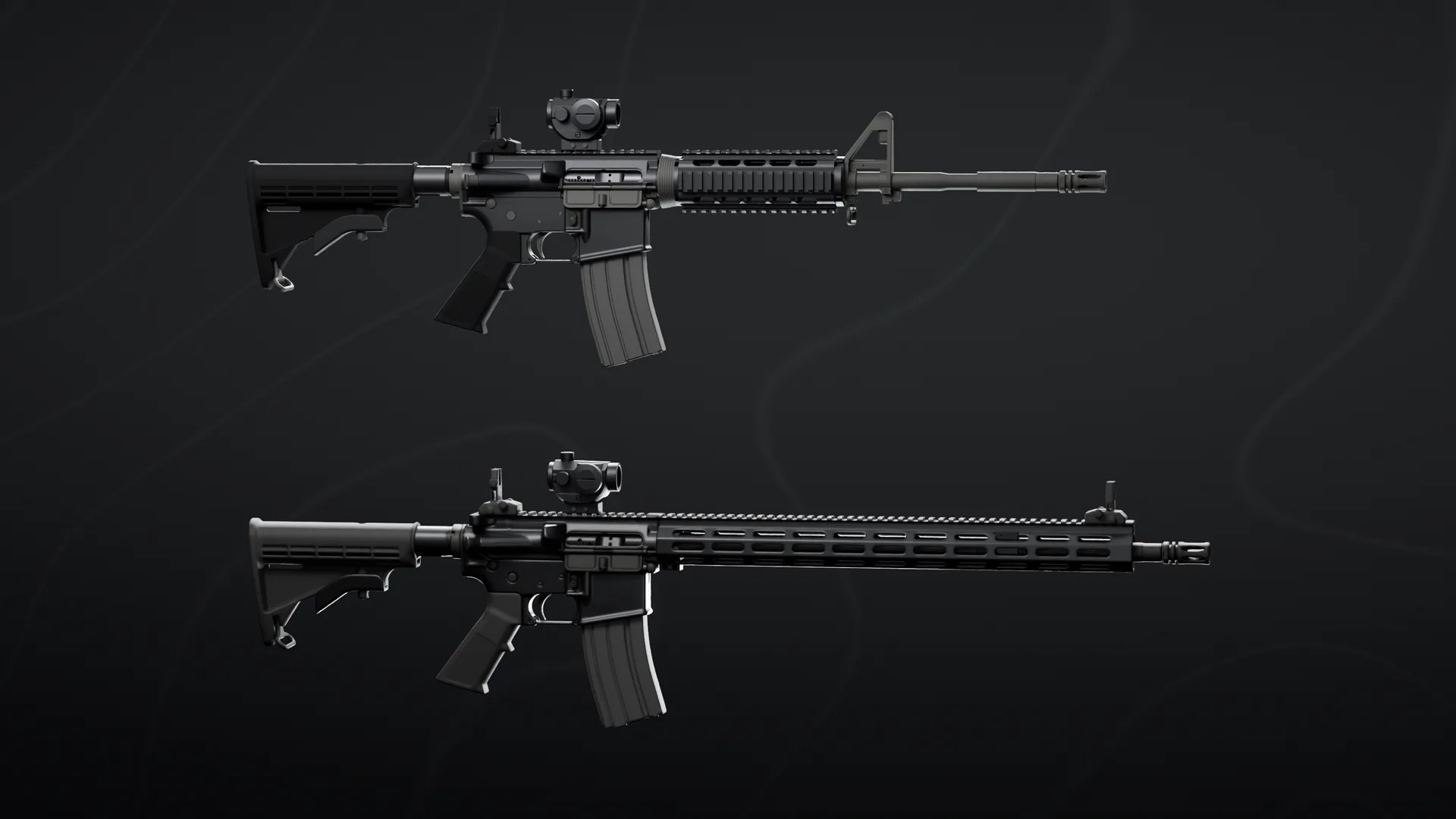
Sight radius is the distance from your rear sight to your front sight. It decides how far one click moves your shot and how much a small sight error costs you. It does not change the bullet path. This is part of the Tactical U rifle explainer series, with AR-15 Zero Explained and Best AR-15 Red Dot Zero.
Quick answer
A shorter sight radius makes every click bigger.
Give a 15.3 inch carbine and a 24.1 inch rifle the same size sight click. At 100 yards, the carbine’s shot moves about 0.67 inch and the rifle’s about 0.43 inch. A longer radius gives you finer clicks. Neither one changes where the bullet goes.
Key Numbers
Both rifles in the video carry the same rear sight in the same place and the same red dot. Only the front sight moves. Sight radius is measured on the models from the rear aperture to the front post.
| Rifle | Sight radius | One click | At 100 yards |
|---|---|---|---|
| Carbine, 16 inch barrel, fixed front sight | 15.3 in | 0.64 MOA | 0.67 in |
| 20 inch rifle, front sight at the end of the rail | 24.1 in | 0.41 MOA | 0.43 in |
You will hear smaller numbers too. The classic carbine with a carry handle is about 14.5 inches, because its rear sight sits farther forward. The classic 20 inch rifle with a carry handle is about 19.75 inches. Where your sights sit sets the radius.
How Sight Radius Changes Each Click
A click moves a sight a tiny amount, about three thousandths of an inch. How much that turns your sight line depends on how far apart the sights are. Divide the move by the sight radius and you get the angle. A longer radius turns the line less, so each click moves the shot less.
You can see it in the military’s own manual. The same style of rear sight is listed at half a minute of angle per click on the classic 20 inch rifle, and three quarters of a minute on the classic carbine.
It is not a straight line. The shorter the sight radius, the faster each click grows. Going from 24 to 15 inches adds about a quarter inch per click at 100 yards. Going from 15 to 8 inches adds about six tenths.
| Sight radius | One click | At 100 yards |
|---|---|---|
| 8 in | 1.23 MOA | 1.29 in |
| 10 in | 0.99 MOA | 1.03 in |
| 12 in | 0.82 MOA | 0.86 in |
| 14 in | 0.71 MOA | 0.74 in |
| 15.3 in | 0.64 MOA | 0.67 in |
| 16 in | 0.62 MOA | 0.65 in |
| 18 in | 0.55 MOA | 0.58 in |
| 20 in | 0.49 MOA | 0.52 in |
| 22 in | 0.45 MOA | 0.47 in |
| 24.1 in | 0.41 MOA | 0.43 in |
| 26 in | 0.38 MOA | 0.40 in |
Four Clicks or Six: What It Looks Like on Paper
Put both rifles on the same 100 yard target, with both groups starting the same distance low. Four clicks up on each, one at a time. The carbine’s hits climb in bigger steps and reach the center. The rifle’s hits climb in smaller steps and need about two more.
| Rifle | After 4 clicks | Clicks to center |
|---|---|---|
| Carbine, 15.3 in | Centered | 4 |
| 20 inch rifle, 24.1 in | About 1 in low | About 6 |
Bigger steps get you there faster but coarser. Smaller steps give you finer control.
Small Sight Errors Cost More on a Short Radius
The same math works against you. Any small error lining up your sights tilts your sight line by that error divided by the sight radius. On these two rifles, the same error moves the shot a little more than one and a half times as much on the carbine as on the rifle.
What Sight Radius Does Not Change
Sight radius does not change the bullet’s path. It only changes how far your shot moves per click and how much a small aiming error costs you. It moves nothing after the bullet leaves the barrel. A longer barrel can change bullet speed, but that comes from the barrel, not from the space between your sights.
Red Dots and Parallax Free
A red dot works differently. There is no front sight and rear sight to line up. You look through one window and put one dot on the target, so there is no sight radius to manage.
You will hear red dots called parallax free. That is only strictly true at one set distance. At other distances, if your eye is off center, the dot can shift on the target. Keep the dot near the center of the window.
What This Means on Your Rifle
- Measure your radius. Measure from the rear aperture to the front sight post. Flip sights on a long rail and a carry handle on a carbine can be several inches apart.
- Treat the box value as a starting point. A stated click value is true at one sight radius. On a shorter rifle each click moves more. On a longer rifle it moves less.
- Confirm it on paper. Fire a group, make a set number of clicks, fire again, and measure the move. Divide by the clicks. At 25 yards, multiply by four to get the 100 yard value.
- Write it down. Keep your click value with your zero notes, so the next adjustment starts from a real number.
More From the AR-15 Explainer Series
This page is one entry in the Tactical U AR-15 explainer series, free training from Tactical U. Each entry answers one question with a short animated film, and each topic has one page. Sight radius lives here. Zeroing and red dot mounts have their own entries:
- AR-15 Zero Explained: how 25, 36, 50 and 100 yard zeros change the bullet path.
- Best AR-15 Red Dot Zero by Riser Height and Barrel Length: a best zero chart for absolute co-witness, lower third, 1.93 and 2.26 mounts.
- Rifle Marksmanship Fundamentals Explained: the seven fundamentals, from stance and mount to sight alignment, trigger control and follow-through.
Rifle Training That Covers Iron Sights
A video can show the math. A class puts it on your rifle, with an instructor watching. These Tactical U rifle pages cover sights and zeroing:
- Tactical Rifle Fundamentals (Rifle Level 1) requires iron sights, with optics allowed as a backup, and has you confirm your zero. Read its gear list first.
- Rifle Training Overview compares the Tactical U rifle classes in one place.
- Rifle Training in Fort Lauderdale covers zero in its Phase 1 carbine training.
What Students Say About Tactical U Rifle Instruction
From Google reviews of Tactical U classes. These reviews describe in-person training, not this video.
“The training is extremely comprehensive and goes deep into how a rifle actually works, while also covering a wide range of possible scenarios.”
“He explained in a logical sequence all aspects of safety, handling and operating the rifle.”
Transcript
Read the full transcript
The question
What is sight radius, and why does it matter? Here are two rifles. Give each one the same size sight click, just one. At one hundred yards, the carbine’s shot moves about two-thirds of an inch. The twenty inch rifle’s shot moves a little over four-tenths. Same size click, different result. The difference is the distance between the sights. That distance is called sight radius.
What sight radius is
Sight radius is the distance from your rear sight to your front sight. On this carbine, measured on the model, it’s fifteen point three inches. On this twenty inch rifle, the front sight sits out at the end of a long rail, so it’s twenty-four point one. You’ll hear smaller numbers too. The classic carbine with a carry handle is about fourteen and a half inches, because its rear sight sits farther forward. The classic twenty inch rifle with a carry handle is about nineteen and three-quarters. Where your sights sit sets the radius.
Click math
A click moves a sight a tiny amount, about three thousandths of an inch. How much that turns your sight line depends on how far apart the sights are. Divide the move by the sight radius, and you get the angle. You can see it in the military’s own manual. The same style of rear sight is listed at half a minute of angle per click on the classic twenty inch rifle, and three-quarters of a minute on the classic carbine. Put that same size click on our two rifles. On the carbine, one click is about two-thirds of a minute of angle, about two-thirds of an inch at one hundred yards. On the twenty inch rifle, it’s about four-tenths of a minute, a little over four-tenths of an inch. And it isn’t a straight line. The shorter the sight radius, the faster each click grows. So when a sight maker tells you one click equals a set amount, that’s only true at the sight radius it was built for. Put that sight on a shorter or longer rifle, and the real value of each click can change a lot.
Watch the hits tick up
Here’s what that looks like on paper at one hundred yards. Both groups start the same distance low. Now four clicks up on each. The carbine’s hits climb in bigger steps and reach the center in four clicks. The rifle’s hits climb in smaller steps. After four clicks they’re still about an inch low, and it takes about two more. Bigger steps get you there faster but coarser. Smaller steps give you finer control. The same math works against you, too. Any small error lining up your sights moves the shot a little more than one and a half times as much on this carbine as on this rifle.
What it does not change
Now the part people mix up. Sight radius does not change the bullet’s path. It only changes how far your shot moves per click, and how much a small aiming error costs you. It moves nothing after the bullet leaves the barrel. A longer barrel can change bullet speed. That comes from the barrel, not from the space between your sights.
The red dot
A red dot works differently. There’s no front sight and rear sight to line up. You look through one window and put one dot on the target. So there’s no sight radius to manage. You’ll hear red dots called parallax free. That’s only strictly true at one set distance, often very far away. At other distances, if your eye is off center, the dot can shift on the target. On a sight set far away, that shift stays small and does not grow with distance the way an iron sight error does. Keep the dot near the center of the window.
Close
A shorter sight radius makes every click bigger and every small error cost more. A longer one gives you finer clicks. Neither changes the bullet. Know your sights, then confirm it on paper. Tactical U. Train, confirm, document.
Limits of These Numbers
- All values are rounded model numbers. The sight radii are measured on the animated rifles, not on a Tactical U range.
- Both rifles get the same size click so the radius is the only difference. Real sights vary by maker, so confirm your own click value on paper.
- The bullet path diagram in the video is a schematic, not to scale. The red dot shift is exaggerated to show the idea.
- Animated with AI.
Train This Skill With Tactical U
Confirm current availability, requirements and total cost before booking.
Sight Radius FAQs
What is sight radius on a rifle?
Sight radius is the distance from your rear sight to your front sight. On the carbine in this lesson it is 15.3 inches, and on the 20 inch rifle it is 24.1 inches, both measured on the models. The classic carry-handle carbine is about 14.5 inches, because its rear sight sits farther forward.
Does a longer sight radius make a rifle more accurate?
It does not change where the bullet goes. A longer sight radius gives you finer clicks and makes a small sight alignment error cost less. In this lesson, the same alignment error moves the shot a little more than one and a half times as much on the 15.3 inch carbine as on the 24.1 inch rifle.
How much does one iron sight click move on an AR-15?
It depends on the sight and on your sight radius. Give both rifles in this lesson the same size click, and at 100 yards the carbine moves about 0.67 inch while the 20 inch rifle moves about 0.43 inch. Confirm your own rifle on paper.
Why does my rear sight not move the shot the amount on the box?
A sight maker states one click value, and that value is only true at the sight radius the sight was built for. Put the same sight on a shorter rifle and each click moves the shot more. Put it on a longer rifle and each click moves it less.
Does sight radius change the bullet path?
No. Sight radius only changes how far your shot moves per click and how much a small aiming error costs you. It moves nothing after the bullet leaves the barrel. A longer barrel can change bullet speed, but that comes from the barrel, not from the space between your sights.
Does a red dot have a sight radius?
No. A red dot has one sighting point, so there is no front and rear sight to line up and no sight radius to manage. Red dots are often called parallax free, but that is only strictly true at one set distance, so keep the dot near the center of the window.
How do I find the real click value on my rifle?
Fire a group at 100 yards, make a set number of clicks, and fire again. Measure how far the group moved and divide by the number of clicks. At 25 yards each click moves the shot a quarter as far, so multiply that result by four to get the 100 yard value.