
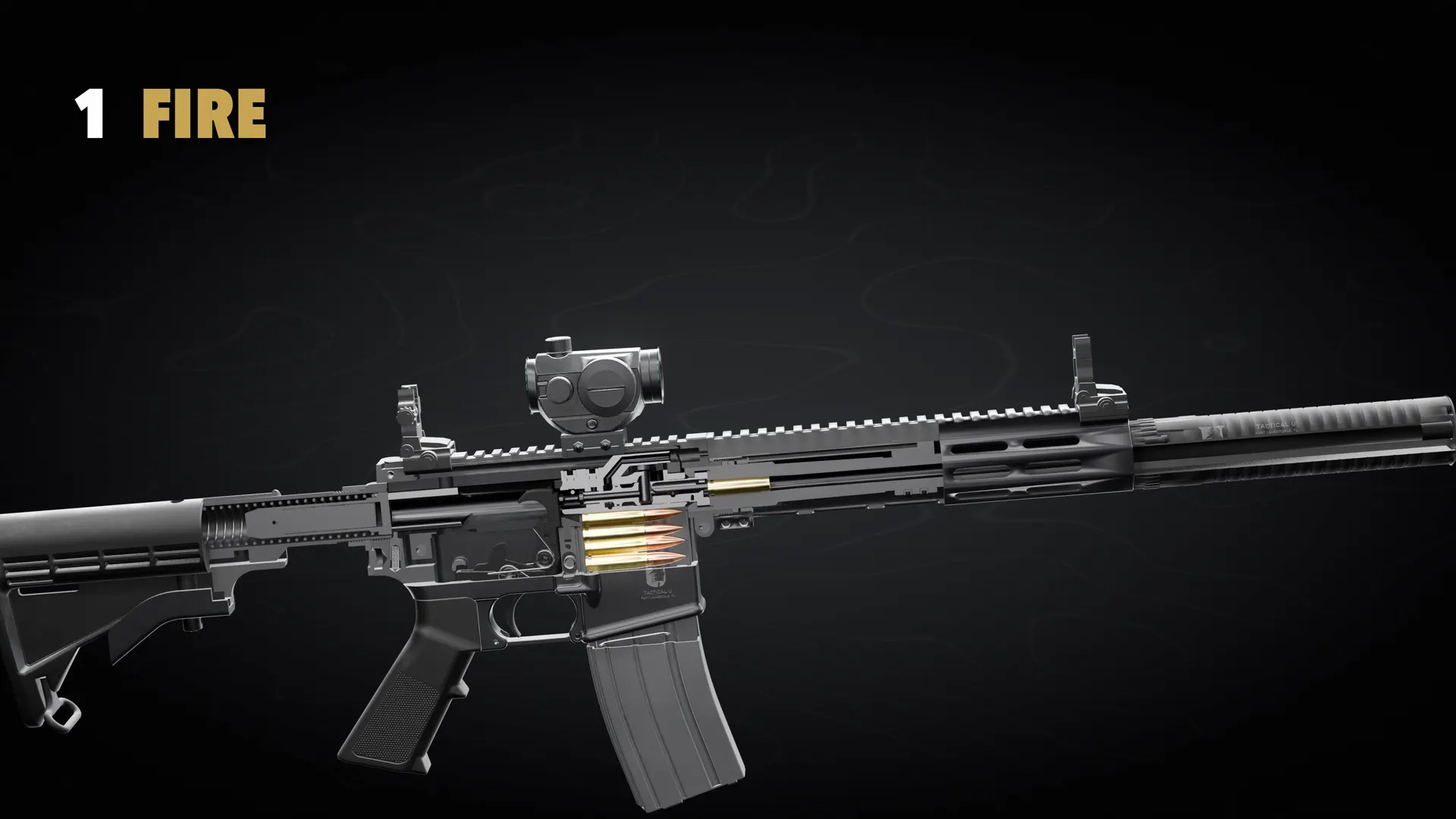
An AR-15 runs the same 8 steps every time it fires: fire, gas, unlock, extract, eject, return, feed and lock. Gas from the fired round drives the bolt carrier back, and a spring drives it home with the next round. This entry is part of the Tactical U Training Encyclopedia, with AR-15 Parts Explained and Iron Sight Radius Explained.
Quick answer
Each shot runs 8 steps, then the rifle is ready again.
Fire, gas, unlock, extract, eject, return, feed, lock. After the last round in the magazine, the bolt locks back. That is how you know the rifle is empty, not jammed.
The 8 Steps
The film runs one magazine through a cut-open rifle. On the first shot it slows down and shows each step in order. The table names each step and what you see when the cycle stops there.
| Step | What happens | If it stops here |
|---|---|---|
| 1. Fire | The hammer drops, the firing pin hits the primer and the round fires. | Click, no bang: a dud round or a light strike. |
| 2. Gas | Gas behind the bullet goes back through the gas tube and pushes the bolt carrier to the rear. | The carrier does not come back far enough: low gas, often called short stroking. |
| 3. Unlock | The carrier rotates the bolt so its lugs come free of the barrel extension. | The bolt stays locked and the action will not open. |
| 4. Extract | The extractor claw pulls the empty case out of the chamber. | The empty case stays in the chamber, and the next round can jam behind it. |
| 5. Eject | The ejector pushes the case out through the ejection port. | A case sticks up in the port, often called a stovepipe. |
| 6. Return | The buffer spring drives the carrier forward again. | The carrier stops short and the bolt does not close. |
| 7. Feed | The bolt strips the next round off the magazine and pushes it into the chamber. | No round chambers: often a magazine problem. |
| 8. Lock | The bolt rotates and locks into the barrel extension, ready to fire. | The bolt is not fully closed: the rifle will not fire. |
Load and Charge
A loaded magazine goes into the magazine well. Pull the charging handle all the way back and let it go. The bolt carrier runs forward, the bolt strips the top round off the magazine, pushes it into the chamber and locks. The rifle is now loaded.
How the Gas Drives the Bolt Carrier
When the bullet passes the gas port near the front of the barrel, some of the gas behind it goes into the gas block and back down the gas tube to the bolt carrier. That push drives the carrier to the rear. As it moves, the carrier turns the bolt to unlock it, and the extractor pulls the empty case out.
The buffer and buffer spring in the stock catch the carrier and send it forward again. On the way forward the bolt picks up the next round and locks. One trigger press, one shot, one full cycle.
Firing to Empty: Why the Bolt Locks Back
The film keeps firing until the magazine is empty. After the last round, the magazine follower pushes the bolt catch up. When the carrier comes back, the catch holds the bolt open. A locked-back bolt on an empty magazine means you are empty, not jammed. Insert a loaded magazine and press the bolt release, or pull and release the charging handle, to load again.
Using the Cycle to Diagnose a Malfunction
Every stoppage is a step that did not finish. Look at the rifle and ask which step stopped. A case left in the chamber is an extraction problem. A case sticking up in the port is an ejection problem. A bolt that will not close is a feed or lock problem. Your instructor teaches the clearing drill for each. This page does not replace that training.
More From the Tactical U Training Encyclopedia
This page is one entry in the Tactical U Training Encyclopedia, free training from Tactical U. Each entry answers one question with a short animated film, and each topic has one page:
- AR-15 Parts Explained: Every major part named and shown working, from the muzzle to the buffer.
- AR-15 Zero Explained: How 25, 36, 50 and 100 yard zeros change the bullet path.
- Best AR-15 Red Dot Zero by Riser Height and Barrel Length: A best zero chart for common red dot mount heights and barrel lengths.
- Iron Sight Radius Explained: Why one sight click moves a carbine more than a 20 inch rifle.
- Rifle Marksmanship Fundamentals Explained: The seven fundamentals, from stance to follow-through.
Rifle Training That Covers This
A video shows how the rifle works. A class puts it in your hands, with an instructor watching. These Tactical U rifle pages cover rifle handling, malfunctions and zeroing:
- Tactical Rifle Fundamentals (Rifle Level 1): handling, loading, malfunction clearing and confirming your zero. Read its gear list first.
- Rifle Training Overview compares the Tactical U rifle classes in one place.
- Rifle Training in Fort Lauderdale covers the same carbine skills in its Phase 1 training.
What Students Say About Tactical U Rifle Instruction
From Google reviews of Tactical U classes. These reviews describe in-person training, not this video.
“The training is extremely comprehensive and goes deep into how a rifle actually works, while also covering a wide range of possible scenarios.”
“He explained in a logical sequence all aspects of safety, handling and operating the rifle.”
Transcript
Read the full transcript
Load and charge
AR-15. Here’s how it cycles. First, load the magazine. Pull the charging handle and let it go. The bolt strips a round and locks.
The 8 steps
One, fire. Two, gas drives it back. Three, it unlocks. Four, extract the case. Five, eject. Six, the spring drives it home. Seven, a new round. Eight, it locks. That leaves three in the magazine.
Fire to empty
Keep firing. Last round. That’s the last one. The bolt locks back on an empty magazine.
End
Tactical U. Train. Confirm. Document.
Limits of This Lesson
- The film shows one animated rifle with a standard direct gas system. Piston rifles move gas differently, but the 8 steps are the same.
- Timing is slowed down to show each step. A real cycle takes a fraction of a second.
- Malfunction signs are common examples, not a full troubleshooting guide. Learn clearing drills from an instructor.
- Animated with AI.
Train This Skill With Tactical U
Confirm current availability, requirements and total cost before booking.
How an AR-15 Works FAQs
How does an AR-15 work?
The AR-15 is gas operated. When a round fires, some of the gas behind the bullet is sent back through the gas tube into the bolt carrier and drives it to the rear. The bolt unlocks, the empty case is pulled out and thrown clear, and the buffer spring drives the carrier forward again to feed the next round and lock. One pull of the trigger fires one round.
What are the 8 steps of the AR-15 firing cycle?
In this lesson: fire, gas drives the carrier back, unlock, extract the case, eject it, the spring drives the carrier home, feed a new round, and lock. Some manuals name the steps differently, such as cocking and chambering, but they describe the same movement.
Why does the bolt lock back on an empty magazine?
After the last round, the magazine follower pushes up on the bolt catch. When the carrier comes back, the catch holds the bolt open instead of letting it close on an empty chamber. A locked-back bolt tells you the rifle is empty, not jammed.
How do I release a locked-back bolt?
Insert a loaded magazine, then press the upper part of the bolt catch, often called the bolt release, or pull the charging handle back and let it go. The bolt runs forward, feeds a round and locks.
Why does knowing the cycle help with malfunctions?
Every stoppage is one step of the cycle that did not finish. If the case stays in the chamber, extraction stopped. If a case sticks up in the ejection port, ejection stopped. If the bolt stops short of closing, feed or lock stopped. Knowing the step tells you the likely fix.
Does the AR-15 fire more than once per trigger pull?
No. A standard AR-15 is semiautomatic: it fires one round each time you press the trigger. The cycle reloads the chamber, but you have to release and press the trigger again to fire the next round.